
(
)
Why AI won't get your positioning right
"Why would I hire Behive if I can just use AI?"
Fair question. And we'd rather answer it honestly than defensively.
Yes, we use AI. Meghan (our AI collaborator and unofficial third member of the team) is part of almost every client process we run. She helps us move fast, think wider, and pressure-test ideas at 11pm when the rest of us have logged off.
So this isn't an argument against AI. It's an argument about what AI alone can't do for your positioning and why that gap is more expensive than it looks.
"So what's the problem?"
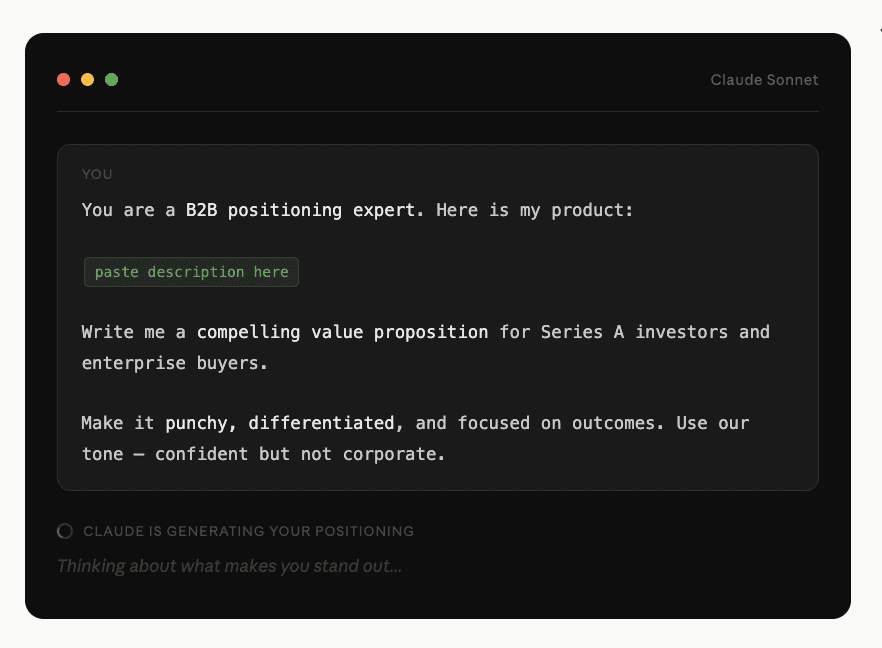
Most founders come to AI with a brief that feels right. The product description refined over a hundred conversations, the value prop they've been pitching for months. And AI does exactly what it's designed to do: takes that input and makes it more polished, more structured, more confident.
It just never stops to ask if the input was right in the first place.
"But I know my product better than anyone."
You do. That's actually part of the problem.
You describe your product the way you understand it. AI mirrors that back.
Nobody in that loop is asking whether that's how your buyer needs to hear it or whether your value prop is built around features when your buyers only care about outcomes.
And here's the other trap: AI is trained on what already exists. It learns from your category, your competitors, the internet's current consensus on what a company like yours should sound like.
Ask it for positioning and it will pull you subtly, convincingly, toward the average.
Toward what's already out there. The very place you need to move away from to stand out.
"So what do you do that's different?"
We start before any execution happens and before we ask you anything, we do our homework.
We listen to what's already being said: social listening, category analysis, cultural trends, what your competitors are claiming and what they're leaving wide open. We come to you already knowing the landscape you're operating in, so the questions we ask aren't generic: they're specific to where your story has the most room to be different.
Then we get into it with you. The uncomfortable questions nobody else is asking. Why this, why now, why you, why should anyone care. We stay with those until the answers are sharp, not just polished.
We think out loud (with you, among ourselves, and yes, with Megan) to find the angles your competitors haven't claimed and the story your buyer actually needs to hear.
That's what we do at Behive.
That foundation is what makes your deck land differently. What makes your website feel like it was written for the person reading it. What makes your pitch stick in the room and travel after you leave.
AI can execute on top of that foundation. It can help you move fast once the thinking is clear.
But it can't build the foundation. That requires someone who pushes back, asks the questions you've been avoiding, and has enough market experience to know the difference between a story that sounds good and one that actually converts.
If you're preparing for a raise, entering a new market, or realizing your current message isn't doing the work it should, let's talk.
More News



TL;DR
Long story short.
We help B2B brands sharpen their positioning, clarify their messaging, and create content people remember.
If people don't get what makes you different, let's talk.
Just click here


(
)
Why AI won't get your positioning right
"Why would I hire Behive if I can just use AI?"
Fair question. And we'd rather answer it honestly than defensively.
Yes, we use AI. Meghan (our AI collaborator and unofficial third member of the team) is part of almost every client process we run. She helps us move fast, think wider, and pressure-test ideas at 11pm when the rest of us have logged off.
So this isn't an argument against AI. It's an argument about what AI alone can't do for your positioning and why that gap is more expensive than it looks.
"So what's the problem?"
Most founders come to AI with a brief that feels right. The product description refined over a hundred conversations, the value prop they've been pitching for months. And AI does exactly what it's designed to do: takes that input and makes it more polished, more structured, more confident.
It just never stops to ask if the input was right in the first place.
"But I know my product better than anyone."
You do. That's actually part of the problem.
You describe your product the way you understand it. AI mirrors that back.
Nobody in that loop is asking whether that's how your buyer needs to hear it or whether your value prop is built around features when your buyers only care about outcomes.
And here's the other trap: AI is trained on what already exists. It learns from your category, your competitors, the internet's current consensus on what a company like yours should sound like.
Ask it for positioning and it will pull you subtly, convincingly, toward the average.
Toward what's already out there. The very place you need to move away from to stand out.
"So what do you do that's different?"
We start before any execution happens and before we ask you anything, we do our homework.
We listen to what's already being said: social listening, category analysis, cultural trends, what your competitors are claiming and what they're leaving wide open. We come to you already knowing the landscape you're operating in, so the questions we ask aren't generic: they're specific to where your story has the most room to be different.
Then we get into it with you. The uncomfortable questions nobody else is asking. Why this, why now, why you, why should anyone care. We stay with those until the answers are sharp, not just polished.
We think out loud (with you, among ourselves, and yes, with Megan) to find the angles your competitors haven't claimed and the story your buyer actually needs to hear.
That's what we do at Behive.
That foundation is what makes your deck land differently. What makes your website feel like it was written for the person reading it. What makes your pitch stick in the room and travel after you leave.
AI can execute on top of that foundation. It can help you move fast once the thinking is clear.
But it can't build the foundation. That requires someone who pushes back, asks the questions you've been avoiding, and has enough market experience to know the difference between a story that sounds good and one that actually converts.
If you're preparing for a raise, entering a new market, or realizing your current message isn't doing the work it should, let's talk.
More News
TL;DR
Long story short.
We help B2B brands sharpen their positioning, clarify their messaging, and create content people remember.
If people don't get what makes you different, let's talk.
Just click here
(
)
Why AI won't get your positioning right
"Why would I hire Behive if I can just use AI?"
Fair question. And we'd rather answer it honestly than defensively.
Yes, we use AI. Meghan (our AI collaborator and unofficial third member of the team) is part of almost every client process we run. She helps us move fast, think wider, and pressure-test ideas at 11pm when the rest of us have logged off.
So this isn't an argument against AI. It's an argument about what AI alone can't do for your positioning and why that gap is more expensive than it looks.
"So what's the problem?"
Most founders come to AI with a brief that feels right. The product description refined over a hundred conversations, the value prop they've been pitching for months. And AI does exactly what it's designed to do: takes that input and makes it more polished, more structured, more confident.
It just never stops to ask if the input was right in the first place.
"But I know my product better than anyone."
You do. That's actually part of the problem.
You describe your product the way you understand it. AI mirrors that back.
Nobody in that loop is asking whether that's how your buyer needs to hear it or whether your value prop is built around features when your buyers only care about outcomes.
And here's the other trap: AI is trained on what already exists. It learns from your category, your competitors, the internet's current consensus on what a company like yours should sound like.
Ask it for positioning and it will pull you subtly, convincingly, toward the average.
Toward what's already out there. The very place you need to move away from to stand out.
"So what do you do that's different?"
We start before any execution happens and before we ask you anything, we do our homework.
We listen to what's already being said: social listening, category analysis, cultural trends, what your competitors are claiming and what they're leaving wide open. We come to you already knowing the landscape you're operating in, so the questions we ask aren't generic: they're specific to where your story has the most room to be different.
Then we get into it with you. The uncomfortable questions nobody else is asking. Why this, why now, why you, why should anyone care. We stay with those until the answers are sharp, not just polished.
We think out loud (with you, among ourselves, and yes, with Megan) to find the angles your competitors haven't claimed and the story your buyer actually needs to hear.
That's what we do at Behive.
That foundation is what makes your deck land differently. What makes your website feel like it was written for the person reading it. What makes your pitch stick in the room and travel after you leave.
AI can execute on top of that foundation. It can help you move fast once the thinking is clear.
But it can't build the foundation. That requires someone who pushes back, asks the questions you've been avoiding, and has enough market experience to know the difference between a story that sounds good and one that actually converts.
If you're preparing for a raise, entering a new market, or realizing your current message isn't doing the work it should, let's talk.
More News
TL;DR
Long story short.
We help B2B brands sharpen their positioning, clarify their messaging, and create content people remember.
If people don't get what makes you different, let's talk.
Just click here