
(
)
Your buyers say they get AI agents.They don't.
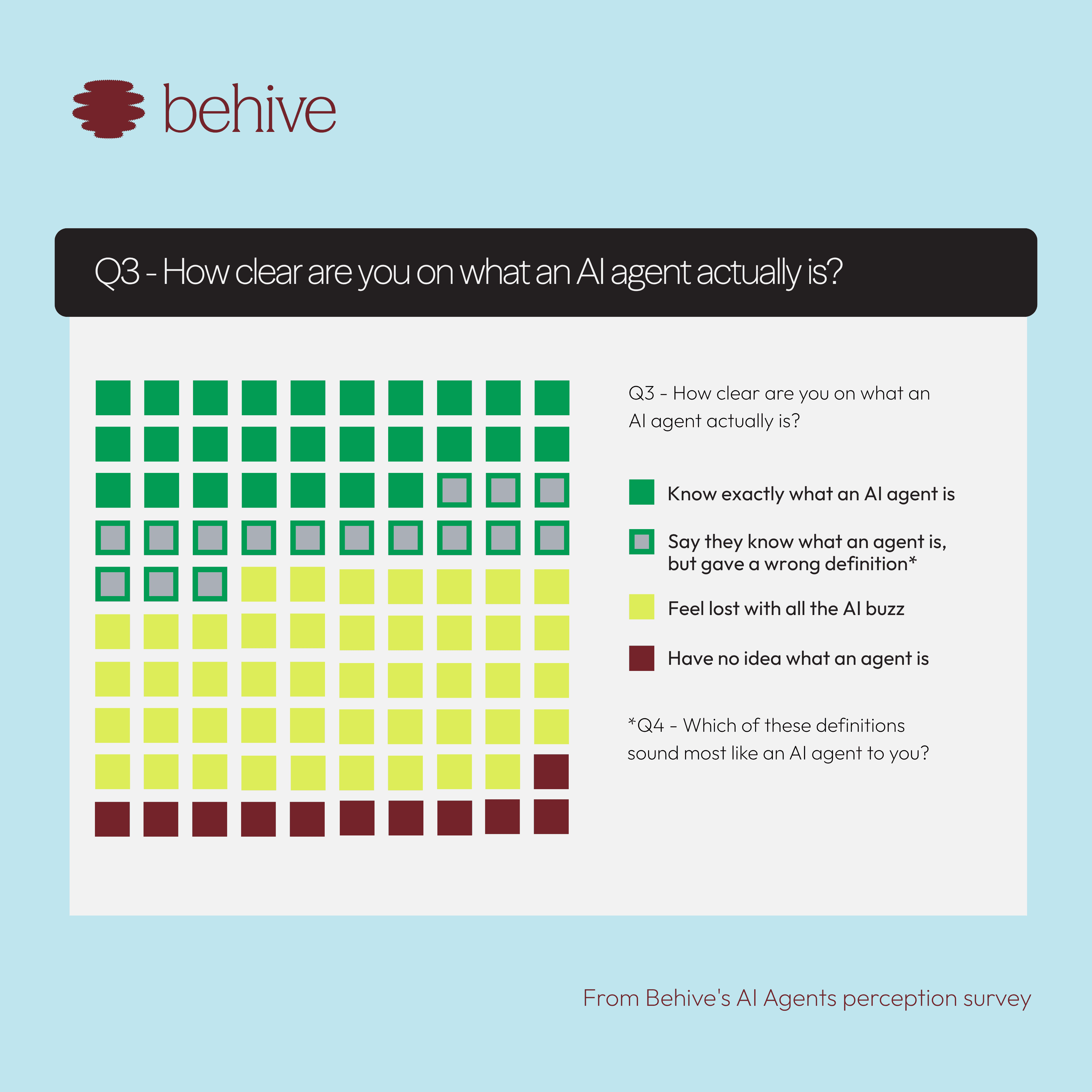
We surveyed 100+ tech professionals to understand how the market actually perceives AI agents.
Every startup deck has them. Every product launch mentions them. Every investor is asking about them. There's just one problem: the people buying these products can't tell you what an AI agent actually is.
We ran a study across 100+ professionals in the tech ecosystem to understand how the market is actually perceiving this category. Not how builders talk about it. How buyers feel about it.
The market isn't scared. It's blank.
Only 6% said AI agents make them uneasy. Fear is not the dominant emotion. Curiosity is. The market is genuinely interested, broadly optimistic, and almost completely unable to act on that interest.
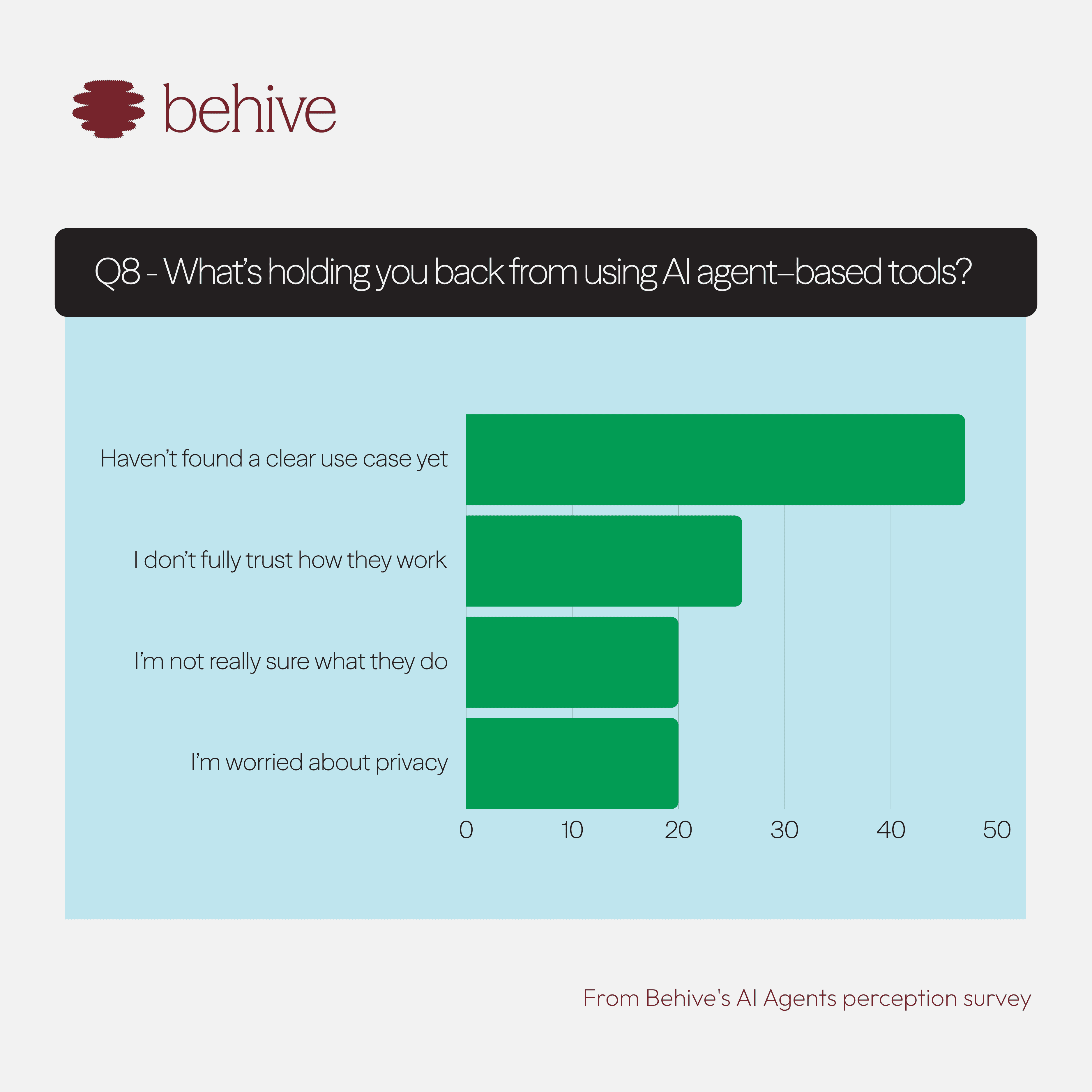
47% said the biggest reason they haven't adopted agents is that they can't find a clear use case for their work. That's not a technology problem. That's a messaging problem.
People hear "AI agent" and feel curious. When asked to connect that to their actual job, nearly half draw a blank.
— Behive AI Agents Study, 2026
Calling yourself an AI agent isn't a strategy.
53% of the market feels positive about AI agents. But that sentiment doesn't convert automatically. The 39% neutral bloc didn't hear "AI agent" and feel something - they heard it and felt approximately nothing. And 14% already associate the term with hype, a number that keeps growing.
The uncomfortable truth: the category label opens the door. It doesn't close the sale. And in 6 months, every competitor will be using it. The window to differentiate is closing before most founders realize it's open.
Whoever translates first, wins.
The gap blocking adoption isn't awareness or sentiment. It sits between "I know what an AI agent is" and "I know what it would do for me, next Tuesday." Almost nobody is bridging it well.
The brands that figure this out first won't just win more deals. They'll shape how the entire category is understood. And once a mental model gets established in a market, it's very hard to dislodge.
The market is warm. Fear is low. Curiosity is real. The only thing missing is someone showing buyers what Tuesday looks like after they say yes.
More News



TL;DR
Long story short.
We help B2B brands sharpen their positioning, clarify their messaging, and create content people remember.
If people don't get what makes you different, let's talk.
Just click here


(
)
Your buyers say they get AI agents.They don't.
We surveyed 100+ tech professionals to understand how the market actually perceives AI agents.
Every startup deck has them. Every product launch mentions them. Every investor is asking about them. There's just one problem: the people buying these products can't tell you what an AI agent actually is.
We ran a study across 100+ professionals in the tech ecosystem to understand how the market is actually perceiving this category. Not how builders talk about it. How buyers feel about it.
The market isn't scared. It's blank.
Only 6% said AI agents make them uneasy. Fear is not the dominant emotion. Curiosity is. The market is genuinely interested, broadly optimistic, and almost completely unable to act on that interest.
47% said the biggest reason they haven't adopted agents is that they can't find a clear use case for their work. That's not a technology problem. That's a messaging problem.
People hear "AI agent" and feel curious. When asked to connect that to their actual job, nearly half draw a blank.
— Behive AI Agents Study, 2026
Calling yourself an AI agent isn't a strategy.
53% of the market feels positive about AI agents. But that sentiment doesn't convert automatically. The 39% neutral bloc didn't hear "AI agent" and feel something - they heard it and felt approximately nothing. And 14% already associate the term with hype, a number that keeps growing.
The uncomfortable truth: the category label opens the door. It doesn't close the sale. And in 6 months, every competitor will be using it. The window to differentiate is closing before most founders realize it's open.
Whoever translates first, wins.
The gap blocking adoption isn't awareness or sentiment. It sits between "I know what an AI agent is" and "I know what it would do for me, next Tuesday." Almost nobody is bridging it well.
The brands that figure this out first won't just win more deals. They'll shape how the entire category is understood. And once a mental model gets established in a market, it's very hard to dislodge.
The market is warm. Fear is low. Curiosity is real. The only thing missing is someone showing buyers what Tuesday looks like after they say yes.
More News
TL;DR
Long story short.
We help B2B brands sharpen their positioning, clarify their messaging, and create content people remember.
If people don't get what makes you different, let's talk.
Just click here
(
)
Your buyers say they get AI agents.They don't.
We surveyed 100+ tech professionals to understand how the market actually perceives AI agents.
Every startup deck has them. Every product launch mentions them. Every investor is asking about them. There's just one problem: the people buying these products can't tell you what an AI agent actually is.
We ran a study across 100+ professionals in the tech ecosystem to understand how the market is actually perceiving this category. Not how builders talk about it. How buyers feel about it.
The market isn't scared. It's blank.
Only 6% said AI agents make them uneasy. Fear is not the dominant emotion. Curiosity is. The market is genuinely interested, broadly optimistic, and almost completely unable to act on that interest.
47% said the biggest reason they haven't adopted agents is that they can't find a clear use case for their work. That's not a technology problem. That's a messaging problem.
People hear "AI agent" and feel curious. When asked to connect that to their actual job, nearly half draw a blank.
— Behive AI Agents Study, 2026
Calling yourself an AI agent isn't a strategy.
53% of the market feels positive about AI agents. But that sentiment doesn't convert automatically. The 39% neutral bloc didn't hear "AI agent" and feel something - they heard it and felt approximately nothing. And 14% already associate the term with hype, a number that keeps growing.
The uncomfortable truth: the category label opens the door. It doesn't close the sale. And in 6 months, every competitor will be using it. The window to differentiate is closing before most founders realize it's open.
Whoever translates first, wins.
The gap blocking adoption isn't awareness or sentiment. It sits between "I know what an AI agent is" and "I know what it would do for me, next Tuesday." Almost nobody is bridging it well.
The brands that figure this out first won't just win more deals. They'll shape how the entire category is understood. And once a mental model gets established in a market, it's very hard to dislodge.
The market is warm. Fear is low. Curiosity is real. The only thing missing is someone showing buyers what Tuesday looks like after they say yes.
More News
TL;DR
Long story short.
We help B2B brands sharpen their positioning, clarify their messaging, and create content people remember.
If people don't get what makes you different, let's talk.
Just click here